

PDRN serum has quickly become one of the most talked-about products in modern skincare, especially among people looking for smoother, hydrated, and healthier-looking skin. The ingredient is widely associated with Korean skincare and regenerative beauty treatments, which has made PDRN products increasingly popular.
But there is an important distinction to understand. PDRN used in professional treatments and PDRN found in topical skincare products are not necessarily equivalent. Injectable PDRN and polynucleotide treatments have a stronger clinical research background, while evidence for topical PDRN serums is still developing. Recent dermatology coverage also points out that the results seen with injectable PDRN should not automatically be expected from an over-the-counter serum.
That does not mean a PDRN serum is useless. Many formulas combine PDRN with ingredients such as peptides, niacinamide, hyaluronic acid, vitamin C, or botanical extracts that can support hydration, brightness, and a smoother skin appearance.
So, what exactly is a PDRN serum, how should you use it, and which products are worth knowing about? Let’s take a closer look.
What Is PDRN Serum?
A PDRN serum is a topical skincare product formulated with PDRN, short for polydeoxyribonucleotide. PDRN refers to fragments of DNA that have been studied for their potential role in tissue repair and regeneration.
In professional medicine, PDRN has been investigated for wound healing and tissue recovery. This clinical background is one reason the ingredient has attracted so much attention in cosmetic skincare.
When you see PDRN in a serum, however, it is important to keep expectations realistic. A topical serum has to work through the outer layers of the skin, and the delivery of larger PDRN molecules to deeper skin targets remains an important scientific question. Current evidence for topical PDRN is much less established than the evidence surrounding medical or injectable applications.
The good news is that PDRN serums often contain other proven skincare ingredients. For example, peptides can support the appearance of firmness, hyaluronic acid helps attract moisture, and niacinamide can help improve the appearance of uneven tone and support the skin barrier.
This combination can make a PDRN serum a useful addition to a well-balanced routine, particularly when your goal is hydrated, smoother-looking skin.

What Are the Benefits of PDRN Serum?
The benefits you get from a PDRN serum depend heavily on the complete formula rather than PDRN alone.
Hydrated-Looking Skin
Many PDRN serums are designed with hydrating ingredients that help the skin feel softer and more comfortable. Hydration can temporarily make fine lines appear less noticeable and give the complexion a healthier glow.
Smoother Skin Texture
A good serum can help improve the feel and appearance of rough or uneven skin. This effect may come from a combination of hydration, humectants, peptides, and other supporting ingredients in the formula.
Supports a Healthy-Looking Skin Barrier
Some PDRN formulas are designed around barrier-supporting ingredients. A healthy skin barrier helps reduce moisture loss and keeps the skin more resilient against everyday environmental stressors.
If your skin frequently feels tight, dry, or irritated, it may be better to focus on barrier-supportive skincare rather than adding several aggressive active ingredients at once.
For more guidance, you can also read our [skin barrier repair] guide when building a routine around hydration and barrier support.
Brighter, More Radiant Appearance
PDRN serums are frequently marketed toward dull or tired-looking skin. However, the brightening effect usually depends on the additional ingredients included in the product.
Vitamin C, niacinamide, peptides, and antioxidant-rich botanical ingredients can all contribute to a brighter-looking complexion.
Firmer-Looking Skin
Some PDRN serums combine PDRN with peptides and other anti-aging ingredients. These formulas may help skin look plumper and more firm with consistent use.
It is better to think of this as cosmetic improvement rather than expecting a topical serum to produce the same effects as an injectable skin treatment.
PDRN Serum vs. Injectable PDRN
This distinction is important because skincare marketing can sometimes make these products sound identical.
Injectable PDRN and topical PDRN serum are delivered into the skin in very different ways. Injectable treatments are performed in a clinical setting, while a serum is applied to the skin surface.
Research supporting PDRN’s regenerative and wound-healing potential largely comes from medical and experimental applications. Experts continue to question how effectively standard PDRN molecules in cosmetic products penetrate the skin deeply enough to reproduce those effects.
Therefore, a PDRN serum should be viewed as a cosmetic skincare product that may support hydration, smoothness, and overall skin appearance—not as a substitute for a professional PDRN treatment.
Seoul Ceuticals Korean Skin Care PDRN Serum
The Seoul Ceuticals Korean Skin Care PDRN + Vitamin C Serum is one option that combines PDRN with a number of other skincare ingredients.
The current formula contains salmon-derived PDRN along with stabilized vitamin C, vitamin E, ferulic acid, hyaluronic acid, centella asiatica, ginseng, and other ingredients. The brand positions the serum around brightness, firmness, smoother-looking texture, hydration, and visible skin repair.
The product is especially interesting for someone who wants both PDRN and brightening ingredients in one serum.
According to the product directions, it is used in the morning after cleansing, toning, and exfoliating. The brand recommends applying 2–3 drops to the face and neck.
One thing to remember is that this formula contains several active and botanical ingredients. If your skin is sensitive, introduce it gradually instead of immediately adding multiple new products.
Innisfree Green Tea PDRN Smoothing Eye & Lip Serum
The innisfree Green Tea PDRN Bounce Booster Eye & Lip Serum takes a slightly different approach because it is designed specifically for the delicate eye and lip areas.
Rather than using traditional salmon-derived PDRN, innisfree describes its Green Tea PDRN™ as a proprietary ingredient derived from a green-tea probiotic process. The formula also contains green tea exosomes, peptides, and an encapsulated retinol complex.
The product is intended to target the appearance of early fine lines around the eyes and lips. It can also be applied directly to the lips according to the brand’s instructions.
Because the formula contains retinol, it is worth treating this product differently from a basic hydrating serum. The brand recommends using it morning and evening and applying sunscreen during the day. It also advises avoiding AHAs and other exfoliating products while using the serum to help minimize irritation.
If your main concern is fine lines around the eyes and lips rather than overall facial skin texture, this type of targeted PDRN product may be more relevant.
What Is Medicube PDRN Pink Peptide Serum?
Medicube PDRN Pink Peptide Serum is another popular product in the PDRN skincare category.
The formula is available with salmon DNA PDRN, while Medicube also offers a Rose PDRN vegan-derived version. The formula combines PDRN with a five-type peptide complex and niacinamide. Medicube positions it around hydration, radiance, uneven tone, elasticity, and a healthier-looking skin barrier.
This makes it different from a simple PDRN-only formula. The peptides and niacinamide are important parts of the overall formulation and may contribute significantly to the visible cosmetic results.
Medicube recommends applying the serum morning and night to clean, dry skin, followed by moisturizer and sunscreen during the daytime.
If you are primarily looking for a PDRN serum for hydration, glow, and firm-looking skin, this type of multi-ingredient formula may be worth considering.
How to Use PDRN Serum
Using a PDRN serum does not have to make your skincare routine complicated.
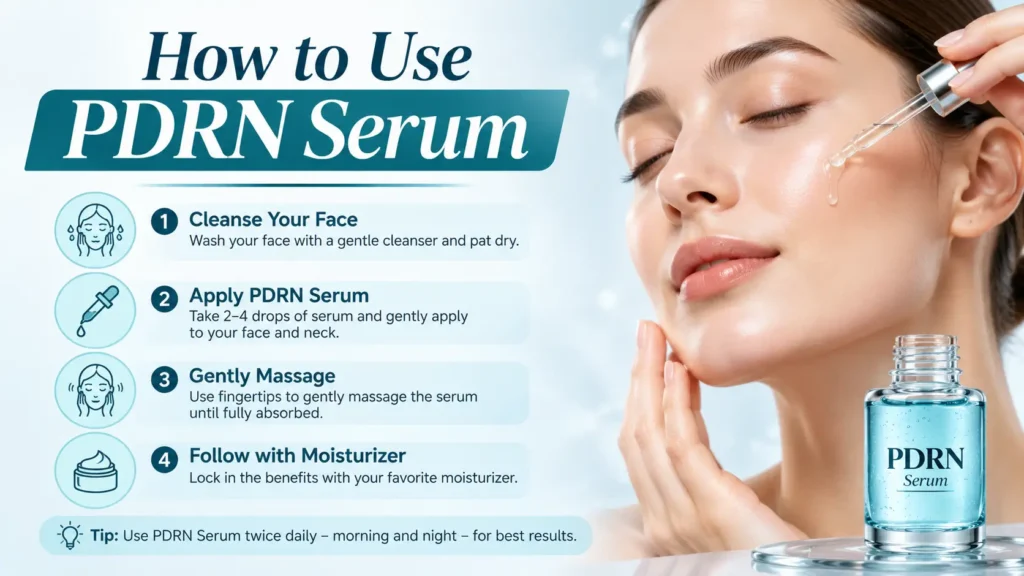
A simple routine can look like this:
Morning
- Cleanse your face with a gentle cleanser.
- Apply toner or essence if you use one.
- Apply a small amount of PDRN serum.
- Follow with moisturizer.
- Finish with broad-spectrum sunscreen.
Evening
- Remove makeup and sunscreen.
- Cleanse your skin.
- Apply toner or essence if desired.
- Apply PDRN serum.
- Finish with moisturizer.
The exact order can change depending on the other products in your routine, but serum generally goes before moisturizer.
If your skin is dry or sensitive, avoid creating a routine with too many strong actives at the same time. A gentle routine can often provide better long-term consistency than constantly switching between aggressive products.
For a simple routine designed around delicate skin, see our [gentle skincare routine for dry sensitive skin] guide.
When to Use PDRN Serum
PDRN serum can generally be used either in the morning, evening, or both, depending on the product’s instructions.
Many PDRN products are marketed for twice-daily use. Medicube, for example, recommends morning and evening application, while Seoul Ceuticals currently recommends its PDRN + Vitamin C serum for morning use. The innisfree Green Tea PDRN Eye & Lip Serum is also directed for AM and PM use.
If you are new to the ingredient, starting once a day can be a practical way to see how your skin responds.
Morning use can be particularly useful when the formula also contains brightening or antioxidant ingredients. Evening use can work well when your routine is focused more on hydration and skin comfort.
Always follow the directions for the specific product you purchase.
Can You Use PDRN Serum Every Day?
Many topical PDRN serums are designed for daily use, but frequency should depend on the complete formula.
PDRN itself is not the only ingredient that matters. A serum may also contain vitamin C, retinol, exfoliating acids, fragrance, botanical extracts, or other active ingredients.
For example, the innisfree Green Tea PDRN Eye & Lip Serum contains an encapsulated retinol complex, so it needs more careful consideration if your routine already contains retinoids or exfoliating acids. The brand specifically recommends avoiding AHA and other exfoliating products while using it.
If you have sensitive skin, start slowly and increase frequency only if your skin remains comfortable.
Is PDRN Serum Good for Acne-Prone Skin?
PDRN serum is not an acne treatment, and it should not replace ingredients specifically supported for acne management.
However, some PDRN formulas may be suitable for acne-prone skin when they are lightweight and contain supportive ingredients that do not irritate the skin.
The important step is checking the complete ingredient list rather than choosing a product simply because it says PDRN on the label.
If you are dealing with active acne, prioritize a simple routine with a gentle cleanser, appropriate acne treatment, moisturizer, and sunscreen. A PDRN serum can be an optional addition rather than the foundation of your acne routine.
If your skin is congested or breaks out easily, introduce only one new product at a time so you can identify what is causing a reaction if one develops.
Can PDRN Serum Help Sensitive or Dry Skin?
A PDRN serum may fit into a routine for dry or sensitive skin, particularly when the formula focuses on hydration and barrier support.
However, PDRN does not automatically make a product suitable for sensitive skin. Other ingredients in the formula matter just as much.
Look for formulas containing gentle moisturizing and soothing ingredients, and be cautious with products that combine PDRN with several strong actives.
If your skin barrier is already compromised, adding retinol, acids, or multiple new serums at the same time can make irritation worse.
For very dry skin, a serum should generally be followed with a moisturizer that helps reduce water loss rather than being used as your only hydrating product.
PDRN Serum vs. Hyaluronic Acid Serum
These two ingredients are often compared because both appear in hydrating skincare routines, but they have different roles.
Hyaluronic acid is primarily known as a humectant that helps attract and hold water, making it useful for increasing the skin’s hydrated appearance.
PDRN is associated with regenerative and tissue-repair research, although the evidence for topical cosmetic PDRN is still developing.
You do not necessarily have to choose between them. A PDRN serum can already contain hyaluronic acid, or you can use separate products if your routine needs additional hydration.

The best choice depends on your main concern:
- Dryness and dehydration: prioritize hydrating ingredients such as hyaluronic acid and glycerin.
- Dullness: consider formulas containing vitamin C or niacinamide.
- Fine lines and firmness: peptides and retinoids have established cosmetic uses.
- Barrier support: look for ceramides, moisturizers, and gentle formulations.
- Curiosity about PDRN: choose a well-formulated serum while keeping expectations realistic.
How to Choose the Right PDRN Serum
Not every PDRN serum is formulated the same way. Before purchasing one, consider the entire ingredient list.
Check the Supporting Ingredients
A serum with PDRN plus peptides, niacinamide, hyaluronic acid, or antioxidants may offer a broader skincare benefit than a formula that focuses heavily on marketing the PDRN ingredient alone.
Consider Your Skin Type
Dry skin may benefit from a richer hydrating formula, while oily or combination skin may prefer a lightweight serum.
Sensitive skin should generally avoid unnecessarily complicated routines and introduce new products slowly.
Look at the Rest of Your Routine
If you already use retinol, vitamin C, AHAs, BHAs, or other active ingredients, check whether the new PDRN serum adds unnecessary overlap.
More active ingredients do not automatically mean better results.
Don’t Judge a Product by the PDRN Label Alone
Current evidence does not support assuming that every topical PDRN serum produces the same effects as clinical PDRN treatments. Product formulation, delivery system, supporting ingredients, and individual skin response all matter.
Common Mistakes When Using PDRN Serum
A few mistakes can make a promising skincare product less useful.
Using too much: A few drops are generally enough for a serum.
Adding several new products at once: This makes it difficult to identify irritation or breakouts.
Skipping sunscreen: A PDRN serum does not replace daily sun protection.
Expecting injectable-level results: Topical PDRN and professional PDRN treatments should not be treated as identical.
Ignoring the complete ingredient list: Supporting ingredients may have a major influence on how the product performs.
Over-exfoliating: Excessive exfoliation can compromise the skin barrier and make even gentle products uncomfortable.
Final Thoughts on PDRN Serum
PDRN serum is an interesting addition to the growing world of advanced skincare, but it is important to separate science from marketing.
PDRN has a legitimate history of medical research, particularly around tissue repair and wound healing. However, the evidence for topical PDRN skincare is still developing, and experts caution against assuming that a serum can reproduce the effects of injectable treatments.
The most sensible approach is to look at the entire formula. Products such as Seoul Ceuticals PDRN + Vitamin C Serum, innisfree Green Tea PDRN Eye & Lip Serum, and Medicube PDRN Pink Peptide Serum combine PDRN-related ingredients with other skincare actives, which may contribute significantly to their cosmetic benefits.
If your goal is healthier-looking, hydrated, smoother skin, a well-formulated PDRN serum can be worth exploring. Just remember that consistent basics—gentle cleansing, moisturizer, appropriate active ingredients, and daily sunscreen—remain the foundation of a good skincare routine.