


Finding the best face wash for fungal acne can be confusing because not every cleanser made for acne-prone skin is suitable for everyone dealing with small, itchy, or uniform-looking bumps. What people commonly call “fungal acne” is often associated with an overgrowth of Malassezia yeast, but similar-looking breakouts can have several different causes.
A good face wash should clean away sweat, excess oil, sunscreen, and daily buildup without leaving the skin excessively dry or irritated. If your skin is sensitive or already inflamed, a harsh cleanser can make the situation feel worse.
The most useful approach is to choose a gentle, fragrance-free cleanser, pay attention to the ingredients, and avoid turning your routine into a long list of strong acne products.
What Is the Best Face Wash for Fungal Acne?
There is no single face wash that works best for everyone with suspected fungal acne. A suitable cleanser should be gentle enough for regular use and should not leave your skin feeling tight, burning, or overly dry.
When choosing a cleanser, consider:
- Gentle cleansing agents
- Fragrance-free formulas
- Lightweight textures
- Minimal unnecessary ingredients
- Products designed for sensitive or acne-prone skin
- Ingredients that your skin has previously tolerated
It is also important to remember that a cleanser is a wash-off product. It has limited contact time with the skin, so it should not be expected to treat a suspected yeast-related skin condition on its own.
What Is Fungal Acne?
“Fungal acne” is a popular skincare term, but it is not the same thing as conventional acne.
The condition people commonly describe as fungal acne is usually Malassezia folliculitis. It occurs when Malassezia yeast contributes to inflammation around hair follicles.
It can sometimes look similar to acne, which makes self-diagnosis difficult.
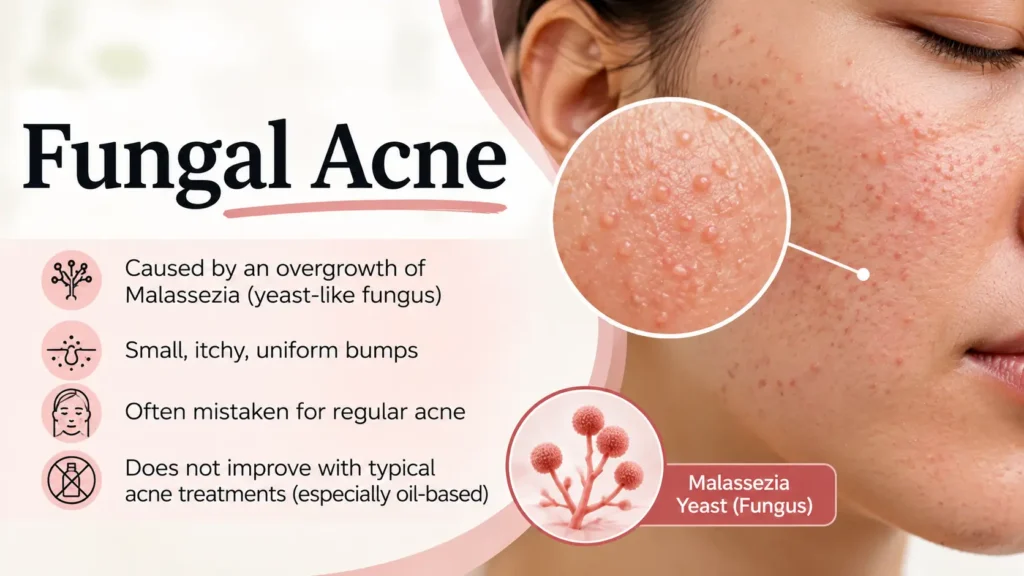
Common Signs of Malassezia Folliculitis
The bumps may appear:
- Small and relatively uniform
- Clustered together
- Itchy
- Around the forehead or hairline
- On the chest, shoulders, or upper back
- More noticeable after sweating or humid weather
However, these signs are not enough to confirm the condition.
Folliculitis can have different causes, and treatments can vary depending on the cause. A dermatologist can help determine what is actually responsible for the bumps.
Best Ingredients to Look for in a Face Wash
When shopping for a face wash for fungal-acne-prone skin, focus first on gentleness rather than trying to find a cleanser with the strongest possible active ingredients.
Salicylic Acid
Salicylic acid is commonly used in acne skincare because it helps exfoliate inside pores and remove dead skin cells.
It can be useful when clogged pores and conventional acne are also part of the problem.
However, using salicylic acid too frequently can cause dryness or irritation, particularly when your skin barrier is already compromised.
Zinc Pyrithione
Zinc pyrithione has historically been used in products aimed at dandruff and certain yeast-related skin concerns.
However, its availability and permitted cosmetic uses vary by country, so check the product label and local regulations rather than assuming every zinc pyrithione product is appropriate for facial use.
Gentle Cleansing Agents
The cleanser does not need to contain multiple active ingredients.
A mild cleanser that removes sweat and excess oil without stripping the skin may be the better everyday choice.
Should You Use an Antifungal Face Wash?
If you genuinely have Malassezia folliculitis, antifungal treatment may be more relevant than a conventional acne cleanser.
However, antifungal medications are different from ordinary face washes.
A dermatologist may recommend an appropriate antifungal treatment depending on the diagnosis and severity.
Do not assume that every itchy bump is fungal acne and start using multiple antifungal products without confirming the cause.
Best Gentle Face Wash for Fungal Acne-Prone Skin
A gentle cleanser can be particularly helpful when your skin is irritated.
Look for:
- Fragrance-free formulas
- Mild cleansing agents
- A comfortable, non-stripping finish
- Simple ingredient lists
- Products suitable for sensitive skin
Why Gentle Cleansing Matters
Aggressive cleansing can remove too much surface oil and leave the skin feeling tight.
That can encourage you to add heavier moisturizers or more products, making the routine increasingly complicated.
The goal is simply to clean the skin without creating additional irritation.
Foaming vs. Non-Foaming Face Wash
Both foaming and non-foaming cleansers can work for acne-prone skin.
The important factor is how your skin responds.
Foaming Cleanser
A gentle foaming cleanser can be useful if you have oily skin or need to remove sunscreen and excess sebum.
Choose one that does not leave your skin feeling stripped.
Cream or Gel Cleanser
A gentle gel or cream cleanser may feel more comfortable if your skin is dry or sensitive.
There is no rule that fungal-acne-prone skin must use one specific cleanser texture.
Face Wash for Oily Skin With Fungal Acne
If your skin becomes oily quickly, you may want a cleanser that removes excess sebum effectively without aggressive scrubbing.
A simple routine might include:
Gentle cleanser → Lightweight moisturizer → Sunscreen
At night, cleanse thoroughly enough to remove sunscreen and daily buildup.
You do not need to wash repeatedly throughout the day.
Face Wash for Dry and Sensitive Skin
Fungal-acne-like bumps can sometimes occur alongside dryness or irritation.
In this situation, choosing an extremely strong cleanser may create another problem.
Look for a gentle cleanser and avoid washing with very hot water.
After cleansing, follow with a moisturizer that your skin tolerates well.
If you are also looking for ways to support dry or sensitive skin, a gentle skincare routine for dry sensitive skin can provide useful guidance on keeping cleansing and moisturizing steps simple.
Can Salicylic Acid Face Wash Help Fungal Acne?
Salicylic acid can help with traditional acne and clogged pores, but it is not an antifungal treatment.
This distinction is important.
If your bumps are actually caused by Malassezia folliculitis, simply using stronger salicylic acid products may not address the underlying cause.
If you have both clogged pores and suspected folliculitis, a dermatologist can help determine which treatments are appropriate.
Can Oil Cleansers Be Used With Fungal Acne?
Oil cleansing is a popular part of many skincare routines, but people concerned about Malassezia folliculitis often become cautious about products containing oils and fatty ingredients.
There is no simple rule that every oil automatically causes fungal acne.
Product formulations are complex, and individual skin responses vary.
If you notice that a particular cleansing product consistently makes your bumps worse, stop using it and simplify your routine.
For people interested in facial oils, choosing an appropriate product based on skin type is more useful than assuming every natural oil will work the same way.
How to Wash Your Face If You Have Fungal Acne
Your cleansing technique matters just as much as your cleanser.
Step 1: Wet Your Face With Lukewarm Water
Avoid very hot water.
Hot water can make already-irritated skin feel more uncomfortable.
Step 2: Use a Small Amount of Cleanser
Apply enough cleanser to cover the face without aggressively rubbing.
Step 3: Massage Gently
Use your fingertips and avoid rough washcloths or physical scrubs.
Step 4: Rinse Thoroughly
Make sure cleanser is removed completely.
Step 5: Pat Dry
Use a clean, soft towel and gently pat rather than rubbing the skin.
Step 6: Moisturize
Apply a suitable lightweight moisturizer if your skin feels dry or tight.
How Often Should You Wash Your Face?
For most people, cleansing once or twice a day is sufficient depending on skin type, makeup, sunscreen, and sweating.
Washing excessively does not necessarily make acne or folliculitis disappear faster.
If you exercise or sweat heavily, cleansing afterward can help remove sweat and buildup.
The goal is clean skin without over-cleansing.
Should You Double Cleanse With Fungal Acne?
Double cleansing is optional.
If you wear makeup or water-resistant sunscreen, an initial cleansing step can help remove those products before your regular cleanser.
But if double cleansing leaves your face tight or irritated, you may not need it every day.
A simple routine is often easier to manage.
Moisturizer After a Face Wash
Cleansing is only one part of skincare.
If your face feels dry after washing, use a moisturizer that suits your skin.
Look for a lightweight, comfortable formula if you dislike heavy products.
If cleansing leaves your skin feeling dry, you may also be interested in learning about the best natural oil for face care. Lightweight options such as jojoba oil or squalane can be considered as an optional moisturizing step, depending on how your individual skin responds.
Why Moisturizer Still Matters
People with acne or suspected fungal acne sometimes avoid moisturizer because they are afraid of making their skin oilier.
However, irritated or dry skin still needs appropriate moisturization.
Skipping moisturizer completely can make a routine harder to tolerate, particularly if you are also using exfoliating or acne treatments.
If you are specifically interested in repairing a damaged or irritated barrier, learning about skin barrier repair can help you build a gentler routine.
Sunscreen for Fungal-Acne-Prone Skin
Sunscreen remains important during the day.
Choose a broad-spectrum sunscreen with SPF 30 or higher and a texture that feels comfortable on your skin.
If a particular sunscreen feels heavy or irritating, try a different formulation rather than skipping sun protection entirely.
Sunscreen is particularly important when you’re dealing with post-breakout discoloration.
Ingredients to Be Careful With
There is a lot of information online about ingredients that are supposedly “safe” or “unsafe” for fungal acne.
Be careful with rigid ingredient lists.
Heavy Fragrance
Fragrance can irritate sensitive skin.
If your face is already itchy or inflamed, a fragrance-free product may be a simpler choice.
Harsh Exfoliants
Using multiple exfoliating products can cause excessive dryness and irritation.
Physical Scrubs
Scrubbing small bumps aggressively will not solve the underlying cause and may increase irritation.
Too Many Active Ingredients
Combining several acids, retinoids, acne treatments, and exfoliating cleansers can make your skin barrier unhappy.
Introduce active ingredients gradually.
Common Mistakes When Choosing a Face Wash
Choosing the Strongest Cleanser
A cleanser does not need to leave your skin squeaky-clean.
That tight feeling is not proof that the cleanser is working better.
Using Several Acne Cleansers
Using one salicylic acid cleanser, another exfoliating cleanser, and multiple treatment products can be excessive.
Pick a basic cleanser and add targeted treatment only when needed.
Assuming Every Bump Is Fungal Acne
This is one of the biggest mistakes.
Small bumps can result from acne, folliculitis, irritation, contact dermatitis, or other conditions.
Treating the wrong condition can delay improvement.
Changing Products Too Quickly
Give your routine enough time to determine whether your skin tolerates a product.
Changing several products at once makes it difficult to identify the source of irritation.
How to Build a Simple Routine
You do not need a complicated routine to care for acne-prone skin.
Morning
1. Gentle cleanser or water rinse
2. Lightweight moisturizer
3. Broad-spectrum sunscreen
Night
1. Gentle cleanser
2. Appropriate treatment if recommended
3. Moisturizer
If your skin is comfortable with this routine, there may be no reason to add several additional products.
How Long Does It Take for Fungal Acne to Improve?
The timeline depends on the actual cause of the bumps and the treatment being used.
If the problem is genuinely Malassezia folliculitis, appropriate treatment can help, but improvement is not necessarily immediate.
If your skin does not improve despite a simple routine, reconsider the diagnosis rather than continually adding new products.
When to See a Dermatologist
Professional evaluation is especially useful if:
- The bumps are very itchy
- Breakouts keep returning
- The condition spreads to the chest or back
- Standard acne products are not helping
- Your skin becomes painful or inflamed
- You develop significant redness or swelling
- You are unsure whether the bumps are acne or folliculitis
- You are developing scars or persistent discoloration
A dermatologist can examine the bumps and determine whether you are dealing with acne, Malassezia folliculitis, another type of folliculitis, or a different skin condition.
Frequently Asked Questions
What is the best face wash for fungal acne?
A gentle, fragrance-free cleanser is a good starting point for skin prone to irritation. If you have confirmed or suspected Malassezia folliculitis, a dermatologist may recommend a treatment specifically appropriate for the underlying condition.
Is salicylic acid good for fungal acne?
Salicylic acid can help with clogged pores and conventional acne, but it does not replace antifungal treatment for Malassezia folliculitis.
Can I wash my face twice a day with fungal acne?
Many people can cleanse once or twice daily depending on their skin type and routine. Avoid excessive cleansing if it causes dryness or irritation.
Is moisturizer necessary with fungal acne?
Yes. Acne-prone skin can still become dry and irritated. Choose a moisturizer that feels comfortable and does not appear to worsen your individual skin concerns.
Can fungal acne go away on its own?
The answer depends on the cause. Persistent or recurring folliculitis should be evaluated rather than repeatedly treated with different acne products.
Should I use a scrub for fungal acne?
A harsh physical scrub is generally not a good solution for itchy or irritated bumps. Gentle cleansing is a better starting point.
Final Thoughts
Choosing the best face wash for fungal acne is less about finding the strongest or most popular cleanser and more about keeping your routine gentle and appropriate for your skin.
A mild, fragrance-free cleanser can remove sweat, excess oil, sunscreen, and daily buildup without unnecessarily irritating the skin. Ingredients such as salicylic acid may be useful when conventional acne or clogged pores are involved, but they should not be mistaken for antifungal treatment.
Most importantly, do not assume every group of small bumps is fungal acne. Malassezia folliculitis can resemble acne, but other skin conditions can look similar. If your bumps are itchy, persistent, recurring, or not responding to your usual routine, getting a proper diagnosis can save you from trying product after product.