

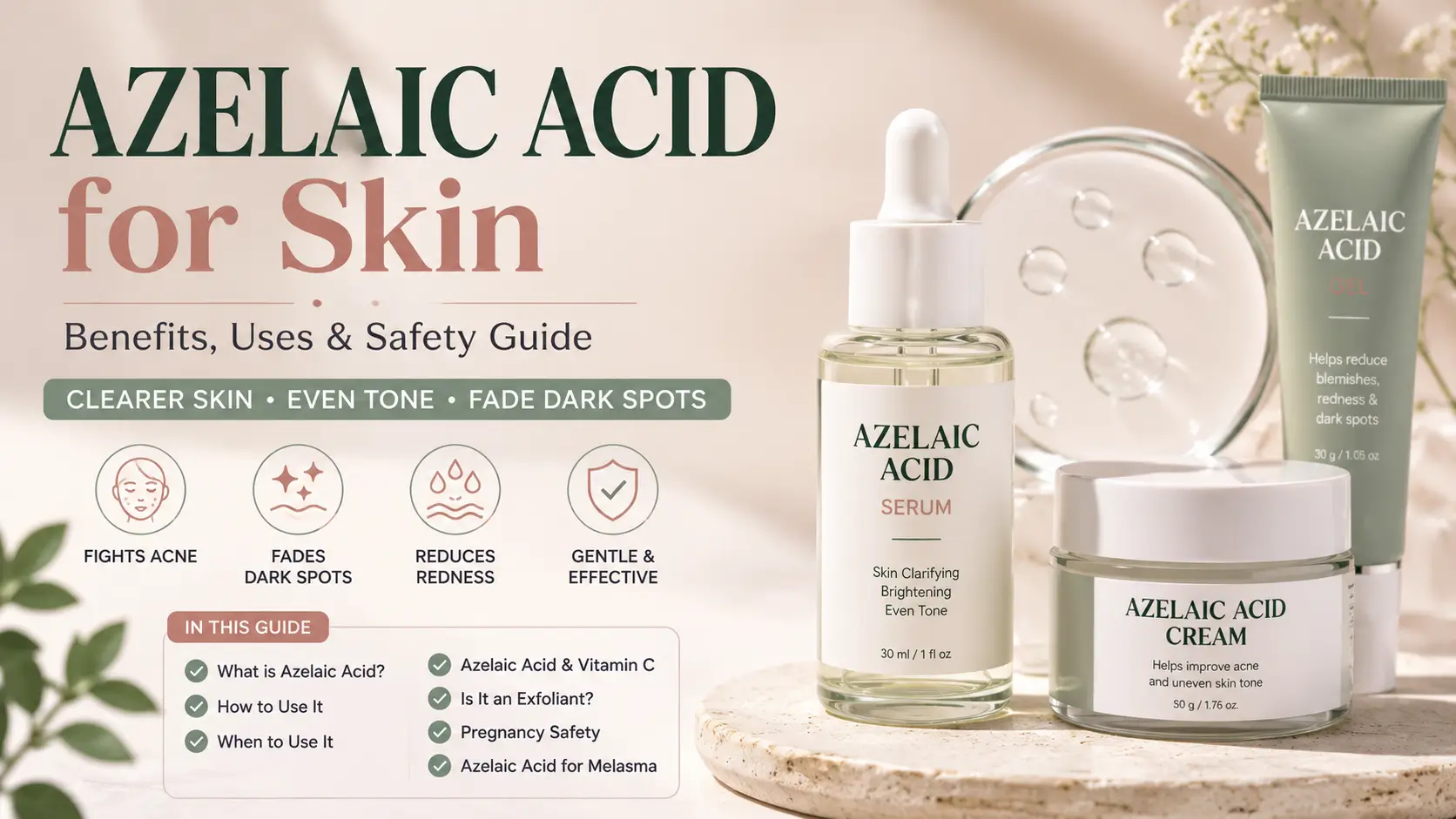
Azelaic acid has become a popular skincare ingredient for people dealing with acne, dark spots, uneven skin tone, redness, and melasma. What makes it especially interesting is that it can address several of these concerns without requiring a complicated skincare routine.
Unlike traditional exfoliating acids, azelaic acid belongs to a different chemical family. It is a dicarboxylic acid that has been used in dermatology for acne and pigmentation-related concerns. Dermatologists may also recommend it for certain forms of rosacea.
For people with acne-prone skin, azelaic acid can help keep pores clear, reduce inflammation, and improve the appearance of dark marks left after breakouts. The American Academy of Dermatology also recognizes topical azelaic acid as an acne treatment and notes that it can help fade dark spots that remain after acne clears.
But how should you use it? Is azelaic acid actually an exfoliant? Can you combine it with vitamin C? And is it safe during pregnancy?
Here is everything you need to know before adding azelaic acid to your skincare routine.
What Is Azelaic Acid for Skin?
Azelaic acid is a naturally occurring dicarboxylic acid that has several dermatological uses. It is available in both prescription treatments and lower-strength cosmetic skincare products, depending on the country and product.
In acne care, azelaic acid can help unclog pores, reduce acne-related bacteria, and calm inflammation. It can also help improve the appearance of post-inflammatory hyperpigmentation, which is why it is often useful for people who experience dark marks after pimples.
Azelaic acid is also used for pigmentation concerns such as melasma. Research has investigated topical 20% azelaic acid for melasma, and dermatologists may include azelaic acid among treatment options for patients who need a gentler alternative to some other pigment-targeting treatments.
This makes azelaic acid different from an ingredient that targets only one concern. It can potentially fit into routines focused on acne, pigmentation, redness, and uneven skin tone.
Benefits of Azelaic Acid for Skin
The benefits of azelaic acid depend on the concentration, formulation, and your individual skin concerns. Some of the most common reasons people use it include the following.
Helps With Acne
Azelaic acid is an established topical option for acne. It can help keep pores clear while addressing bacteria and inflammation associated with breakouts.
This makes it particularly useful for people who have both active blemishes and the dark marks that appear afterward.
Rather than using it only on individual pimples, acne medications are often more effective when applied as directed across the acne-prone area. The AAD recommends applying topical acne medication according to the treatment instructions rather than treating only the spots that are already visible.
Helps Fade Post-Acne Dark Spots
A pimple may disappear, but the discoloration it leaves behind can remain for much longer.
Azelaic acid can help improve the appearance of these dark marks by affecting processes involved in melanin production. The AAD lists azelaic acid among ingredients that can help fade existing dark spots.
This makes it a particularly useful ingredient for people whose main concern is not only acne but also the uneven pigmentation that follows it.
May Improve Uneven Skin Tone
If your complexion looks uneven because of post-acne marks or certain pigmentation concerns, azelaic acid may help create a more even-looking appearance over time.
However, pigmentation usually requires patience. Applying more product will not necessarily make dark spots disappear faster.
Daily sun protection is also essential because UV exposure can worsen pigmentation and make treatment more difficult.
Can Help With Redness
Azelaic acid is also used in dermatology for certain forms of rosacea, particularly when redness occurs along with inflammatory bumps and pustules.
However, not every type of facial redness is rosacea or acne. Persistent redness, burning, flushing, or recurring bumps should be evaluated by a dermatologist before starting an aggressive treatment routine.
Supports Smoother-Looking Skin
Azelaic acid has mild keratinization-normalizing and pore-clearing effects. As congestion and uneven surface buildup improve, skin can look smoother and more refined.
This is one reason it can be useful for people who want a smoother complexion without relying on multiple exfoliating acids.

Is Azelaic Acid an Exfoliant?
This is a common question because azelaic acid is an acid, but it is not the same type of exfoliant as glycolic acid, lactic acid, or salicylic acid.
Azelaic acid is a dicarboxylic acid, while glycolic and lactic acids are alpha hydroxy acids and salicylic acid is a beta hydroxy acid.
So, should you consider it an exfoliant?
Not in the traditional AHA/BHA sense.
Azelaic acid does have effects on keratinization and can help keep pores from becoming clogged, so it can produce some effects that people associate with exfoliating ingredients. However, its dermatological benefits extend beyond simply removing dead skin cells.
This distinction matters because you should not assume that azelaic acid can be layered with unlimited amounts of other exfoliating acids simply because it is considered a “gentle acid.”
If your skin is sensitive, introducing several acids at the same time can still cause irritation.
Best Azelaic Acid: What Should You Look For?
When people search for the best azelaic acid, there is no single product that is ideal for everyone.
The better approach is to choose a formula based on your skin type, concern, and tolerance.
For Acne-Prone Skin
Look for a lightweight formula that fits comfortably into your existing acne routine.
If you already use benzoyl peroxide, salicylic acid, or a retinoid, introducing azelaic acid gradually can help reduce the chance of irritation.
For Dark Spots and Uneven Tone
Look for a well-formulated azelaic acid product and pair it with consistent sunscreen.
Azelaic acid can support the appearance of dark spots, but sun protection is an important part of any pigmentation-focused routine. The AAD recommends broad-spectrum sunscreen as part of melasma care and recommends SPF 30 or higher.
For Sensitive Skin
A simpler formula may be easier to tolerate.
Avoid introducing several new actives simultaneously. If your skin is already irritated, focus first on gentle cleansing and moisturizing before adding another treatment ingredient.
For additional guidance, see our gentle skincare routine for dry sensitive skin guide.
How to Use Azelaic Acid
Using azelaic acid does not need to make your skincare routine complicated.
A basic routine can look like this:
Morning:
- Gentle cleanser
- Hydrating toner or essence, if desired
- Azelaic acid
- Moisturizer
- Broad-spectrum sunscreen
Evening:
- Cleanser
- Azelaic acid
- Moisturizer
The exact order can vary depending on the product’s texture and instructions.
If you are using a prescription azelaic acid treatment, follow your healthcare professional’s instructions rather than copying the routine of an over-the-counter product.

Start Slowly
If you have never used azelaic acid before, start with a few applications per week.
If your skin remains comfortable, you can gradually increase frequency according to the product instructions.
Starting slowly is especially helpful if your routine already includes other active ingredients.
When to Use Azelaic Acid
Azelaic acid can often be used in either the morning or evening, depending on the specific product and your routine.
If you use it in the morning, apply sunscreen afterward. This is especially important when your goal is improving pigmentation because UV exposure can make dark spots and melasma more difficult to control.
If your routine contains several other active ingredients, using azelaic acid at night may make it easier to avoid unnecessary layering.
There is no universal rule saying that azelaic acid must be used only at night. The best time is the one that allows you to use it consistently without irritating your skin.
Azelaic Acid and Vitamin C
Azelaic acid and vitamin C can both be useful for people concerned about uneven skin tone and dark spots.
Vitamin C is an antioxidant commonly used to support brighter-looking skin, while azelaic acid can target acne, inflammation, and pigmentation-related concerns.
They can potentially be included in the same overall skincare routine, but you do not have to apply both at the same time.
For beginners or sensitive skin, a simpler approach may be:
Morning: Vitamin C → moisturizer → sunscreen
Evening: Azelaic acid → moisturizer
This separation is not mandatory. It is simply an easy way to introduce both ingredients while reducing the amount of active layering.
If your skin tolerates both products well, they may also be used in the same routine according to their individual instructions.

Can You Use Azelaic Acid With Niacinamide?
Yes, azelaic acid and niacinamide can be a practical combination.
Niacinamide is commonly used for barrier support, oil control, and improving the appearance of uneven tone, while azelaic acid provides more targeted treatment benefits for acne and pigmentation.
If you have sensitive skin, you may find it easier to use a formula that already contains supportive ingredients rather than layering several separate serums.
Can You Use Azelaic Acid With Retinol?
Azelaic acid and retinol can both be useful ingredients, but combining them immediately may be too irritating for some people.
If you already use retinol, consider introducing azelaic acid on alternate nights.
For example:
- Monday: Retinol
- Tuesday: Azelaic acid
- Wednesday: Recovery night
- Thursday: Retinol
- Friday: Azelaic acid
- Weekend: Recovery or treatment according to tolerance
There is no need to follow this exact schedule. The important point is to introduce active ingredients gradually and adjust according to your skin’s response.
Is Azelaic Acid Pregnancy Safe?
This is one of the most important questions for anyone considering azelaic acid during pregnancy.
Current pregnancy guidance generally considers topical azelaic acid an acceptable acne-treatment option when needed. MotherToBaby notes that the American College of Obstetricians and Gynecologists has suggested over-the-counter topical products containing azelaic acid as an option during pregnancy.
However, pregnancy skincare should still be individualized.
Check the complete ingredient list because a product marketed as an “azelaic acid serum” may contain other active ingredients that are not appropriate during pregnancy.
If you are pregnant, trying to become pregnant, or breastfeeding, it is sensible to discuss your complete skincare routine with your healthcare provider, particularly when using prescription-strength products or multiple active ingredients.
Azelaic Acid for Melasma
Azelaic acid for melasma has received attention because it can help target pigmentation without relying exclusively on stronger pigment treatments.
Melasma is a chronic pigmentation condition that commonly appears as darker patches on areas such as the cheeks, forehead, nose, chin, and upper lip.
Research has investigated 20% azelaic acid for melasma. A systematic review and meta-analysis of randomized controlled trials found that azelaic acid may reduce melasma severity, although the researchers also noted the need for larger studies and longer-term evidence.
A separate clinical trial also found improvement in melasma severity among participants using topical 20% azelaic acid over 24 weeks.
Sunscreen Is Essential for Melasma
Azelaic acid should not be viewed as a standalone solution for melasma.
The AAD emphasizes daily sun protection because sunlight can increase pigment production, worsen existing melasma, and contribute to recurrence. Dermatologists commonly recommend broad-spectrum SPF 30 or higher, along with other sun-protective measures.
For melasma-prone skin, a consistent routine is generally more useful than constantly changing treatments.
Azelaic Acid for Acne-Prone Skin
Azelaic acid can be a useful ingredient when acne and post-acne pigmentation occur together.
For example, someone may experience:
- Occasional inflamed pimples
- Small clogged pores
- Dark marks after breakouts
- Uneven-looking skin tone
Azelaic acid can potentially address several of these concerns within one routine.
However, moderate or severe acne may require a more comprehensive treatment plan. The AAD’s acne guidelines recommend several topical options, including azelaic acid, but the best treatment depends on the type and severity of acne.
If your acne is painful, widespread, scarring, or not improving, consider seeing a dermatologist.
Azelaic Acid for Dark Spots
Dark spots can develop after acne, irritation, inflammation, or sun exposure.
Azelaic acid can be particularly useful for post-inflammatory hyperpigmentation because it addresses both acne and pigmentation concerns.
However, irritating your skin can sometimes make pigmentation more noticeable. This is why aggressive exfoliation is not always the best approach.
If you are working on dark spots, keep the rest of your routine gentle and make sunscreen a daily habit.
Can Azelaic Acid Cause Irritation?
Although azelaic acid can be well tolerated by many people, irritation is still possible.
You may experience:
- Mild stinging
- Burning
- Dryness
- Itching
- Redness
- Peeling
These effects can be more noticeable when you first start using the ingredient or when it is combined with multiple other actives.
If irritation is persistent or severe, stop using the product and seek professional advice.
How Long Does Azelaic Acid Take to Work?
Azelaic acid is not an overnight treatment.
Acne, dark spots, and pigmentation develop over time, so improvement also tends to take time.
The timeline depends on the condition being treated, the concentration of the product, how consistently you use it, and your individual skin.
For melasma in particular, dermatologists emphasize that treatment takes time and may require a combination of sun protection and topical treatments. The AAD notes that melasma treatment commonly takes several months before noticeable results are seen.
Instead of changing products every few days, give your routine enough time to evaluate whether it is helping.
Common Mistakes When Using Azelaic Acid
Using Too Much
Applying a thicker layer does not automatically make azelaic acid work faster.
Follow the amount recommended on the product label or by your healthcare professional.
Starting Every Active at Once
Adding azelaic acid, retinol, vitamin C, salicylic acid, and exfoliating acids simultaneously makes it difficult to know what your skin tolerates.
Introduce products one at a time.
Skipping Moisturizer
Active ingredients work better as part of a balanced routine rather than being used on already-irritated skin.
A suitable moisturizer can help maintain skin comfort while you use azelaic acid.
For more information about supporting your skin barrier, see our skin barrier repair guide.
Forgetting Sunscreen
If you are using azelaic acid for pigmentation or melasma, sunscreen should be a non-negotiable part of your morning routine.
Without adequate sun protection, pigmentation can remain difficult to control.
Expecting It to Remove Acne Scars
Azelaic acid may help fade dark marks left after acne, but that is different from treating true depressed or raised acne scars.
Structural acne scars may require professional treatments depending on their type.
Who Should Consider Azelaic Acid?
Azelaic acid may be worth considering if you are dealing with:
- Mild to moderate acne
- Post-acne dark marks
- Uneven skin tone
- Certain types of redness
- Melasma
- Congested-looking skin
It may be especially appealing if you want one ingredient that can address both breakouts and the pigmentation that follows them.
However, the right routine depends on your individual skin. A product that works well for one person may cause irritation for another.
Should You Add Azelaic Acid to Your Skincare Routine?
Azelaic acid is a versatile ingredient with established dermatological uses for acne and pigmentation, and it may also be used for certain rosacea-related concerns.
Its appeal comes from its ability to address multiple skin concerns without functioning like a traditional AHA or BHA exfoliant.
If you are mainly dealing with acne and post-acne marks, azelaic acid can be a particularly useful option. If melasma is your main concern, it may also have a place in a broader treatment plan that includes consistent sun protection.
If you prefer incorporating facial oils into your routine, you can also explore our best natural oil for face guide to choose an oil based on your skin’s needs.
Final Thoughts
Azelaic acid for skin is worth considering if your routine needs an ingredient that can address several concerns at once.
It can help with acne, post-acne dark marks, uneven-looking skin tone, and certain forms of redness. Research also supports its use as an option for melasma, although pigmentation conditions often require patience and consistent sun protection.
The best azelaic acid is not necessarily the strongest product or the one with the most impressive marketing. A suitable formulation that your skin can tolerate consistently is usually a better choice.
Start slowly, avoid overwhelming your skin with too many active ingredients, moisturize regularly, and use sunscreen every morning. If you are pregnant, have persistent skin problems, or are using prescription treatments, discuss your routine with a healthcare professional.
With a simple and consistent approach, azelaic acid can become a useful part of a skincare routine focused on clearer, more even-looking, and healthier-looking skin.