

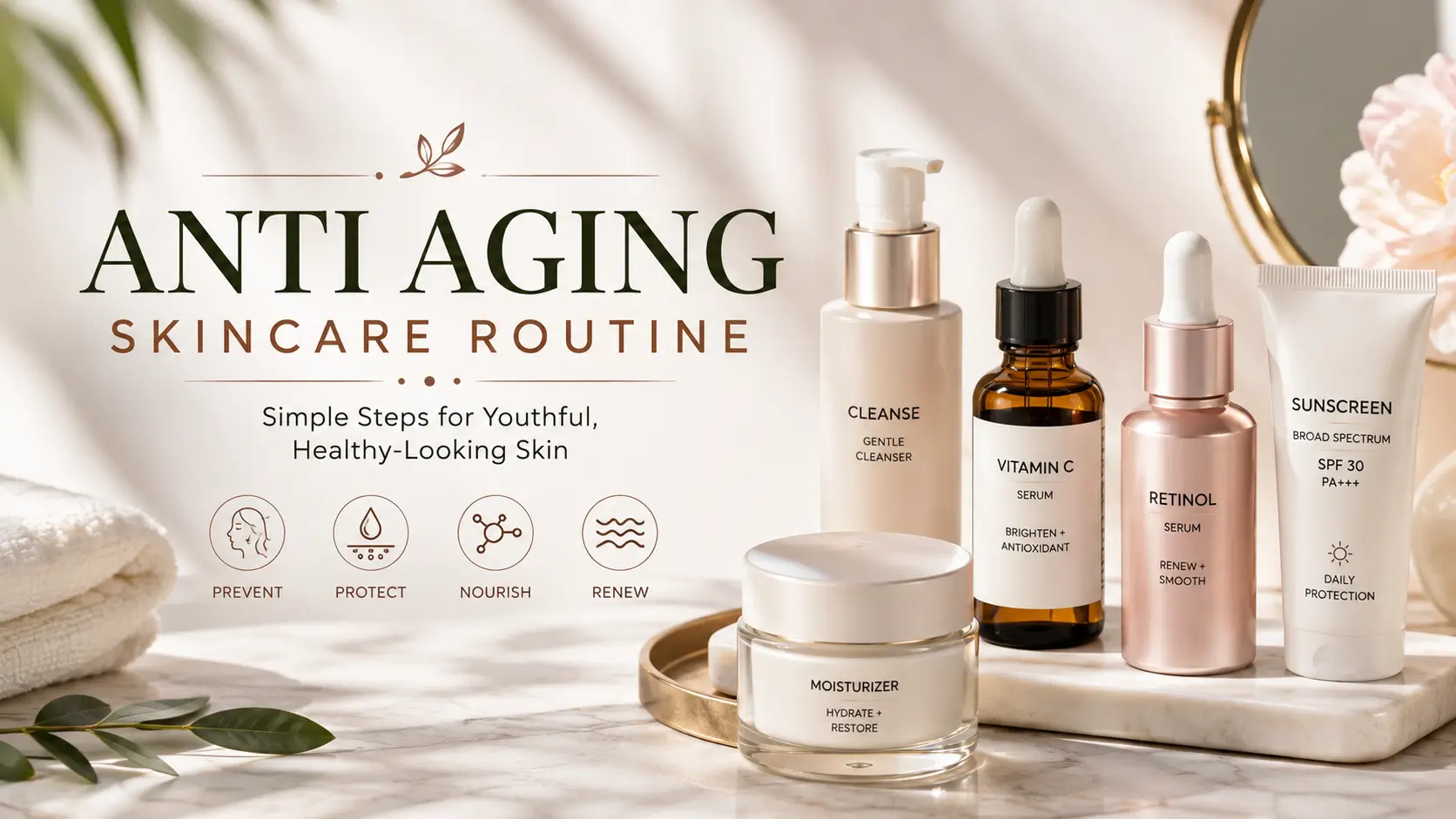
An effective anti aging skincare routine does not have to involve a shelf full of products. The best approach is to focus on the basics first: protect your skin from the sun, keep it moisturized, cleanse gently, and introduce targeted ingredients when your skin needs them.
Fine lines, uneven skin tone, dryness, and loss of firmness are natural parts of skin aging. While skincare cannot stop the aging process, the right routine can help reduce the appearance of some visible signs and keep your skin looking healthy and well cared for.
Consistency matters more than using the most expensive products. In fact, dermatologists identify sunscreen and moisturizer as two of the most effective foundations of an anti-aging skincare routine.
Morning Skincare Routine for Anti Aging
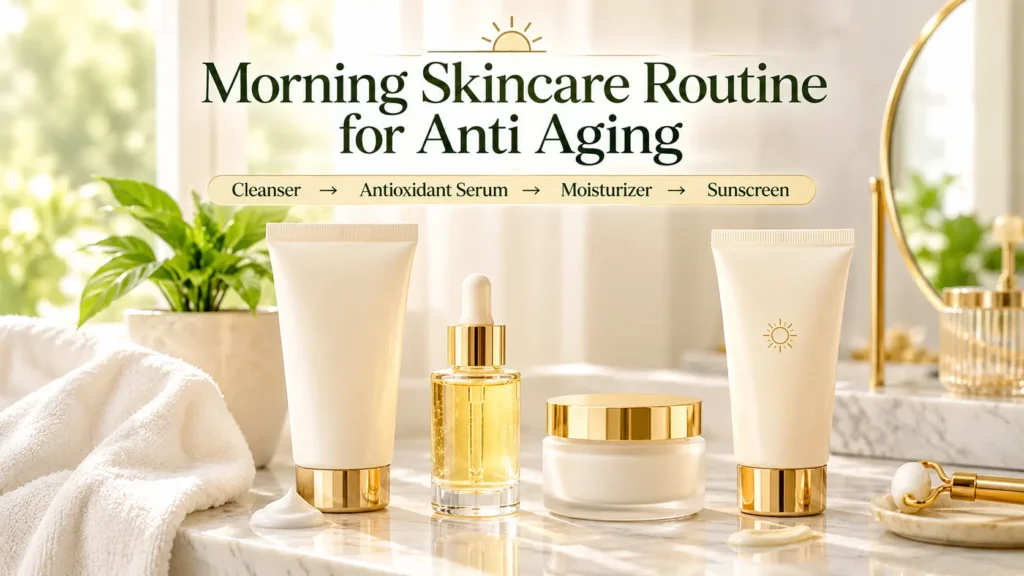
Your morning routine should focus primarily on protection, hydration, and antioxidant support.
A simple order is:
Cleanser → Antioxidant Serum → Moisturizer → Sunscreen
You can add other products depending on your skin type and concerns, but these steps provide a practical starting point.
Step 1: Start With a Gentle Cleanser
Begin your morning with a gentle cleanser that removes overnight oil and buildup without stripping your skin.
Avoid harsh scrubbing or very hot water. Irritating the skin can make signs of aging more noticeable, so gentle cleansing is preferable.
If your skin is very dry, you may not need an aggressive morning cleanse. A mild cleanser or another gentle approach may be more comfortable.
Step 2: Add an Antioxidant Serum
An antioxidant serum can complement your morning routine.
Vitamin C is one popular option because it is used in skincare for concerns such as dark spots and visible signs of skin aging.
Other formulas may contain ingredients such as:
- Vitamin E
- Ferulic acid
- Niacinamide
- Green tea extracts
You do not need multiple antioxidant serums. Choose one product that suits your skin and use it consistently.
Step 3: Apply Moisturizer
Moisturizer is an important part of an anti-aging routine because hydrated skin can look smoother and more supple.
As skin ages, it can become drier, making fine lines more noticeable. Moisturizer helps trap water in the skin and can temporarily make fine lines appear less visible.
Look for ingredients such as:
- Ceramides
- Hyaluronic acid
- Glycerin
- Squalane
Choose the texture according to your skin type rather than choosing the richest product available.
Step 4: Finish With Sunscreen
If you only make one anti-aging step a daily habit, make it sunscreen.
Sun exposure plays a major role in premature skin aging, including wrinkles, uneven pigmentation, and other visible changes. Dermatologists recommend a broad-spectrum sunscreen with SPF 30 or higher.
Apply sunscreen as the final step of your morning skincare routine.
If you are outdoors for an extended period, reapply according to the product directions and your level of sun exposure.
Anti Ageing Skincare Routine
An anti ageing skincare routine should work with your skin rather than overwhelm it.
A practical nighttime routine can be:
Cleanser → Targeted Treatment → Moisturizer
The treatment step is where you can address specific concerns such as fine lines, uneven texture, dullness, or pigmentation.
Step 1: Remove Makeup and Sunscreen
At night, remove makeup and sunscreen before going to bed.
If you wear long-lasting makeup or water-resistant sunscreen, you may prefer a cleansing balm, cleansing oil, or another first cleanser followed by a gentle facial cleanser.
The goal is clean skin without excessive rubbing.
Step 2: Use a Retinoid or Retinol
Retinoids are among the better-known ingredients for addressing visible signs of skin aging.
Retinol is an over-the-counter type of retinoid commonly used to improve the appearance of fine lines, uneven skin tone, pigmentation, and texture.
If you are new to retinol, start slowly.
For example, you might begin with a few nights per week rather than applying it every night immediately.
Retinoids can cause dryness and irritation, particularly when introduced too quickly. Starting with a lower-intensity product and gradually increasing use can help improve tolerance.
Important: Retinoids should not be used during pregnancy. If you are pregnant, trying to become pregnant, or unsure whether a retinoid is appropriate for you, speak with your healthcare professional.
Step 3: Moisturize After Treatment
Finish your nighttime routine with moisturizer.
If retinol makes your skin feel dry, moisturizer can make the routine more comfortable.
Some people also use a moisturizer before their retinoid when they are especially sensitive. The right approach depends on the product and how your skin responds.
Best Anti Aging Skincare Ingredients
You do not need every popular anti-aging ingredient.
Instead, choose ingredients based on the specific concerns you want to address.
Retinol and Retinoids
Retinoids support skin cell turnover and are widely used to improve the appearance of fine lines and wrinkles.
Retinol is generally more accessible for beginners because it is available in many over-the-counter products.
Start gradually and follow the product directions.
Vitamin C
Vitamin C is a popular antioxidant for morning skincare.
It can help support brighter-looking skin and is commonly used for concerns such as uneven tone and visible signs of skin aging.
It pairs naturally with a morning routine because sunscreen provides the primary daily protection while vitamin C adds antioxidant support.
Niacinamide
Niacinamide is a versatile ingredient that can fit into many skincare routines.
It is often included in products designed to support an even-looking complexion, skin barrier, and overall skin conditioning.
It is also available in many different product types, including serums and moisturizers.
Hyaluronic Acid
Hyaluronic acid is a hydrating ingredient that can help skin feel softer and more moisturized.
It does not need to be treated as a stand-alone anti-aging treatment. Its main value in this type of routine is supporting hydration and a smoother-looking complexion.
Ceramides
Ceramides are lipids found naturally in the skin barrier.
They are commonly used in moisturizers because they help support the skin’s protective barrier and hydration.
This becomes particularly useful when your routine contains active ingredients that can cause dryness.
Peptides
Peptides are found in many anti-aging skincare formulas.
They can be included in serums or moisturizers designed to support smoother, firmer-looking skin.
If you use a peptide product, think of it as one part of your routine rather than something that needs to replace sunscreen or moisturizer.
Anti Aging Skincare Routine for Different Skin Types
Your routine should change according to how your skin behaves.
For Dry Skin
Focus on hydration and barrier support.
Choose:
- Cream or lotion cleanser
- Hydrating serum
- Richer moisturizer
- Gentle retinoid introduction
- Daily sunscreen
Look for ingredients such as ceramides, glycerin, hyaluronic acid, and squalane.
For Oily Skin
Oily skin still needs moisturizer.
Choose lightweight, non-comedogenic formulas that provide hydration without feeling heavy.
A gel moisturizer can be a comfortable option for some people.
For Combination Skin
Combination skin may need different textures in different areas.
Use lightweight hydration overall and apply richer moisturizer to areas that become dry.
Avoid treating your entire face aggressively just because your T-zone is oily.
For Sensitive Skin
Sensitive skin benefits from a simple routine.
Start with:
Gentle Cleanser → Moisturizer → Sunscreen
Then introduce one active ingredient at a time.
If a product repeatedly burns or irritates your skin, stop using it. Dermatologists note that irritating the skin can make signs of aging more noticeable.
How to Use Retinol in an Anti Aging Routine
Retinol can be useful, but more is not better.
Start with a small amount and use it according to the product instructions.
A beginner-friendly approach is:
Cleanse → Allow skin to dry → Apply retinol → Moisturize
If dryness develops, reduce how frequently you use it.
You can also focus on moisturizer and gentle cleansing on nights when you are not using retinol.
Do not immediately combine retinol with several strong exfoliating products. Too many active ingredients can increase irritation, and dermatologists recommend introducing anti-aging products carefully rather than using multiple products at once.
Should You Exfoliate for Anti Aging?
Exfoliation can help remove dead skin cells and improve the appearance of dull or rough skin.
However, it is not essential to exfoliate aggressively to maintain youthful-looking skin.
Chemical exfoliants can include:
- Lactic acid
- Glycolic acid
- Mandelic acid
- Salicylic acid
- Polyhydroxy acids
If you already use a retinoid, introduce exfoliation carefully.
Using too many active products can irritate the skin. If your face feels sore, unusually dry, red, or uncomfortable, simplify your routine.
How to Layer Anti Aging Skincare Products
A simple product order makes your routine easier to follow.
Morning
1. Cleanser
2. Vitamin C or antioxidant serum
3. Moisturizer
4. Sunscreen
Night
1. Cleanser
2. Retinol or another targeted treatment
3. Moisturizer
If you use additional products, generally apply lighter textures before heavier ones.
Most importantly, follow the instructions for the individual products you use.
Common Anti Aging Skincare Mistakes
Even a good skincare routine can become less effective when products are used incorrectly.
Using Too Many Products
Adding several anti-aging products at once can irritate the skin.
Dermatologists recommend starting with one product, testing it, and giving it time to work before adding more.
Skipping Sunscreen
No serum can replace daily sun protection.
UV exposure contributes significantly to premature skin aging, so sunscreen should remain a consistent part of your morning routine.
Applying Too Much Retinol
Using more retinol will not necessarily make it work faster.
Excessive use can increase dryness and irritation.
Follow the product instructions and increase frequency gradually.
Scrubbing Your Skin
A rough scrub may leave your face feeling temporarily smooth, but excessive physical exfoliation can irritate the skin.
Gentle cleansing is a better everyday habit.
Expecting Overnight Results
Most anti-aging products require consistent use.
The AAD notes that while moisturizer can temporarily plump fine lines relatively quickly, many anti-aging products take at least several weeks to show noticeable results, and some can take longer.
Anti Aging Skincare Routine in Your 20s
Your 20s are a good time to establish protective habits rather than focusing only on correcting wrinkles.
Prioritize:
- Daily sunscreen
- Gentle cleansing
- Moisturizer
- Antioxidants if desired
- Healthy lifestyle habits
You may not need several powerful anti-aging treatments at this stage.
Prevention and consistency are more useful than trying to use every trending ingredient.
Anti Aging Skincare Routine in Your 30s
In your 30s, you may begin noticing subtle changes in texture, pigmentation, or fine lines.
A practical routine can include:
Morning:
Cleanser → Vitamin C → Moisturizer → Sunscreen
Night:
Cleanser → Retinol → Moisturizer
You can adjust the routine depending on your skin concerns.
Anti Aging Skincare Routine in Your 40s and Beyond
As skin becomes drier with age, hydration and barrier support become increasingly important.
You may want to focus on:
- Gentle cleansing
- Richer moisturizer when needed
- Sunscreen
- Retinoid if suitable
- Antioxidant ingredients
- Hydrating serums
Dermatologists also recommend maintaining healthy habits such as sun protection, moisturizing, gentle cleansing, adequate sleep, and a balanced diet as part of an overall skin-aging plan.
How Long Does an Anti Aging Routine Take to Work?
Skincare results take time.
Hydration can make your skin look smoother relatively quickly, but changes involving fine lines, pigmentation, or texture generally require more patience.
Give a new product enough time to show whether it works for you before replacing it.
The AAD notes that many anti-aging products need at least six weeks of consistent use, and some can take around three months to show results.
Taking photos every few weeks in similar lighting can be more useful than checking your skin for changes every morning.
Simple Anti Aging Skincare Routine for Beginners
If you are completely new to anti-aging skincare, start with the essentials.
Morning
Cleanser → Moisturizer → SPF 30+ Sunscreen
After your skin is comfortable with this routine, you can add an antioxidant serum.
Night
Cleanser → Moisturizer
Once your basic routine is established, consider adding a retinol product gradually if it is suitable for your skin.
This approach keeps your routine manageable and makes it easier to identify which products are helping or irritating your skin.
Lifestyle Habits That Support Healthy-Looking Skin
Skincare is only one part of maintaining healthy-looking skin.
Daily habits can also matter.
Protect Your Skin From Excessive Sun
Seek shade when appropriate and use sun-protective clothing in addition to sunscreen when spending significant time outdoors.
Avoid Tanning
Tanning exposes the skin to UV radiation and can accelerate visible signs of aging.
Get Enough Sleep
Adequate sleep gives your body time to recover and supports overall health.
Eat a Balanced Diet
A diet containing fruits, vegetables, lean proteins, and healthy fats supports overall health and can complement a good skincare routine.
Avoid Smoking
Smoking can contribute to premature skin aging and a dull, dry-looking complexion.
When to See a Dermatologist
Skincare products are useful for many everyday concerns, but they cannot treat every sign of skin aging.
Consider seeing a dermatologist if you have:
- Deep or rapidly changing wrinkles
- Persistent pigmentation
- Significant skin laxity
- Severe irritation
- Persistent redness
- A changing or unusual skin lesion
- A concern that does not improve with basic skincare
A dermatologist can identify your specific skin concerns and recommend treatments that are appropriate for your skin.
Final Thoughts
A successful anti aging skincare routine does not need to be complicated.
Start with the foundations: gentle cleansing, moisturizer, and daily broad-spectrum SPF 30 or higher sunscreen. Then add targeted ingredients such as vitamin C or retinol based on your skin concerns and tolerance.
The biggest mistake is trying to achieve results faster by using too many active ingredients. A simple routine used consistently is often a better approach.
Give your products time to work, protect your skin from the sun, and adjust your routine as your skin changes. With these habits in place, your skincare routine can support a healthier, smoother, and more youthful-looking complexion over time.