

If you keep getting small, itchy bumps, redness, or rough patches on your face that do not respond to your usual acne routine, you may be dealing with a fungal or yeast-related skin condition rather than traditional acne. In these situations, an antifungal face wash may be useful as part of an appropriate skincare or treatment routine.
However, choosing an antifungal cleanser is not simply about finding the strongest product available. Facial skin can become dry and irritated when exposed to unnecessary medicated ingredients, and several conditions can look surprisingly similar. Malassezia folliculitis, for example, can resemble acne because it produces small bumps around hair follicles.
The right approach is to understand what is causing the bumps, identify useful antifungal ingredients, and choose a cleanser that supports the skin barrier instead of stripping it.
What Is an Antifungal Face Wash?
An antifungal face wash is a cleanser designed to help reduce or control fungi or yeast associated with certain skin conditions. Depending on the formulation, it may contain an antifungal medication or another ingredient with antimicrobial properties.
One condition commonly associated with antifungal treatment is Malassezia folliculitis, sometimes called pityrosporum folliculitis. Malassezia yeasts normally live on human skin, but under certain conditions they can contribute to follicular inflammation and acne-like bumps.
An antifungal cleanser can be helpful when a fungal or yeast-related condition has been identified, but it is not automatically the right treatment for every breakout. Acne vulgaris, bacterial folliculitis, rosacea, eczema, and contact dermatitis can produce overlapping symptoms.
That distinction matters because treating the wrong condition may leave the actual problem unresolved.
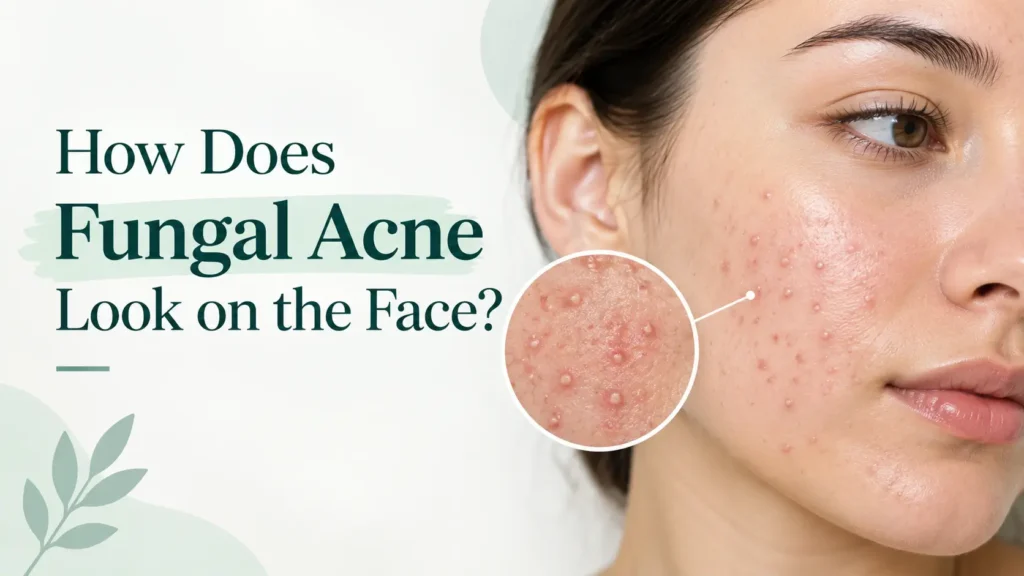
How Does Fungal Acne Look on the Face?
The term “fungal acne” is commonly used online, but dermatologists generally refer to this condition as Malassezia folliculitis or pityrosporum folliculitis.
It often produces small, fairly uniform bumps around hair follicles. It may also be itchy, and some people notice redness or scaling around the affected area. The forehead and hairline can be involved, although Malassezia folliculitis can occur in other areas containing hair follicles as well.
Some signs that may make a yeast-related follicular condition worth discussing with a dermatologist include:
- Small, similar-looking bumps appearing in clusters
- Itching accompanying the bumps
- Breakouts around the forehead or hairline
- Symptoms that become more noticeable in hot or humid conditions
- A breakout that does not behave like your usual acne
- Flaking or scaling alongside acne-like bumps
These signs are clues, not a diagnosis. Malassezia folliculitis can resemble acne and other types of folliculitis, so persistent or unusual facial breakouts should be evaluated rather than diagnosed solely from appearance.
Antifungal Face Wash vs. Regular Acne Cleanser
One of the biggest mistakes people make is assuming that every acne-like breakout needs an acne cleanser.
Traditional acne and Malassezia folliculitis have different underlying mechanisms. Acne vulgaris commonly involves clogged pores, inflammation, and changes involving skin bacteria, while Malassezia folliculitis involves an overgrowth of yeast within hair follicles.
This means a cleanser designed primarily for oil control or acne may not address a yeast-related condition.
At the same time, using an antifungal cleanser when you simply have ordinary acne may not solve the problem either. The goal is not to use the most aggressive cleanser; it is to match the treatment to the skin condition.
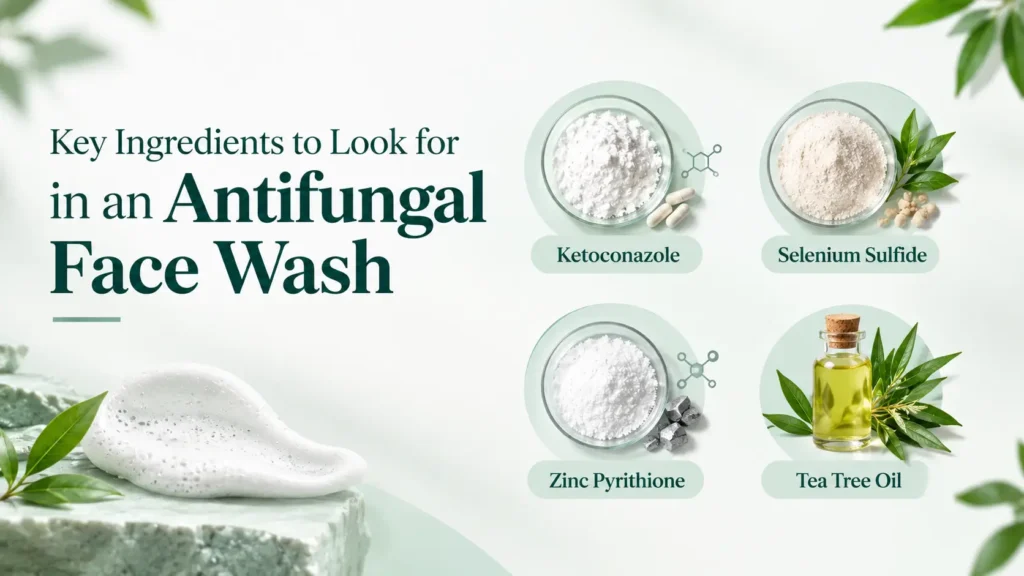
Key Ingredients to Look for in an Antifungal Face Wash
When comparing an antifungal face wash, pay attention to its active ingredients rather than relying only on marketing terms such as “fungal acne safe” or “anti-breakout.”
Ketoconazole
Ketoconazole is a genuine antifungal medication used against several fungal and yeast-related skin conditions. Dermatology references describe topical ketoconazole as one of the treatments used for Malassezia-related conditions and seborrhoeic dermatitis.
Ketoconazole may be available in creams and medicated shampoos depending on the country and product. Some formulations are used on areas of facial skin when medically appropriate.
Because ketoconazole is a medication rather than an ordinary cosmetic cleanser, it should be used according to the product instructions or a healthcare professional’s advice.
Selenium Sulfide
Selenium sulfide is another antifungal ingredient used in certain medicated products. DermNet lists selenium sulfide shampoo among topical treatment options for Malassezia folliculitis.
It may be particularly relevant when a person has overlapping scalp or seborrhoeic dermatitis symptoms, although the appropriate product and method of use depend on the condition being treated.
Zinc Pyrithione
Zinc pyrithione has historically been used in products designed for dandruff and seborrhoeic dermatitis. DermNet notes it as an alternative option in some cases where Malassezia-associated seborrhoeic dermatitis is involved.
Its availability and permitted uses can vary by country, so check the actual product formulation and local labeling.
Tea Tree Oil
Tea tree oil is frequently included in products marketed toward blemish-prone or fungal-prone skin because it has antimicrobial properties. However, it should not automatically be considered equivalent to a proven medicinal antifungal treatment.
Concentrated essential oils can also irritate sensitive facial skin. If you choose a cosmetic cleanser containing tea tree oil, a gentle formulation is preferable to an extremely concentrated product.
How to Choose the Best Antifungal Face Wash for Your Skin
There is no single best antifungal face wash for everyone because the appropriate choice depends on the condition being treated, the active ingredient, skin sensitivity, and whether a medical diagnosis has been established.
Instead of choosing based on popularity alone, consider these factors.
1. Identify the Problem First
Before buying a medicated cleanser, consider whether your symptoms actually resemble a fungal or yeast-related condition.
If the bumps are itchy, very uniform, persistent, or repeatedly return despite conventional acne treatment, it may be worth getting a professional assessment.
2. Check the Active Ingredient
Look beyond the front label. Check whether the product actually contains an ingredient intended to address fungal or yeast-related skin problems.
For medically diagnosed Malassezia-related conditions, ingredients such as ketoconazole and selenium sulfide may be used as part of treatment.
3. Consider Your Skin Barrier
An antifungal product does not need to leave your skin extremely tight or dry to be effective.
If your face becomes irritated after cleansing, look for a gentler formulation and avoid combining several potentially irritating active ingredients at once.
The objective is to control the underlying problem while maintaining a healthy skin barrier.
4. Avoid Over-Cleansing
Washing your face repeatedly throughout the day does not necessarily make a fungal-related condition disappear faster.
Over-cleansing can cause dryness and irritation. If you are using a medicated product, follow its directions rather than increasing the frequency yourself.
5. Be Careful With the Eye Area
Medicated antifungal products are not automatically appropriate for eyelids or directly around the eyes. Avoid getting medicated cleansers or shampoos into the eyes and follow the product’s instructions carefully.
If irritation occurs, stop and seek advice from a pharmacist or healthcare professional.
Can You Use Antifungal Shampoo as a Face Wash?
This is a common skincare question because some antifungal shampoos contain ingredients such as ketoconazole or selenium sulfide.
Certain medicated shampoos are used on facial skin for conditions such as seborrhoeic dermatitis under appropriate guidance. DermNet, for example, lists ketoconazole shampoo among topical treatments for seborrhoeic dermatitis affecting the scalp and face.
However, that does not mean every dandruff shampoo is automatically suitable for your face.
Facial skin can be more sensitive than the scalp, and some formulas may cause dryness or irritation. If you are considering using a medicated shampoo on your face, check the product directions and ask a pharmacist or dermatologist whether it is appropriate for your particular condition.
For ketoconazole products, NHS guidance also emphasizes following the instructions supplied with the medicine and notes that irritation can occur if products are used incorrectly or too frequently.
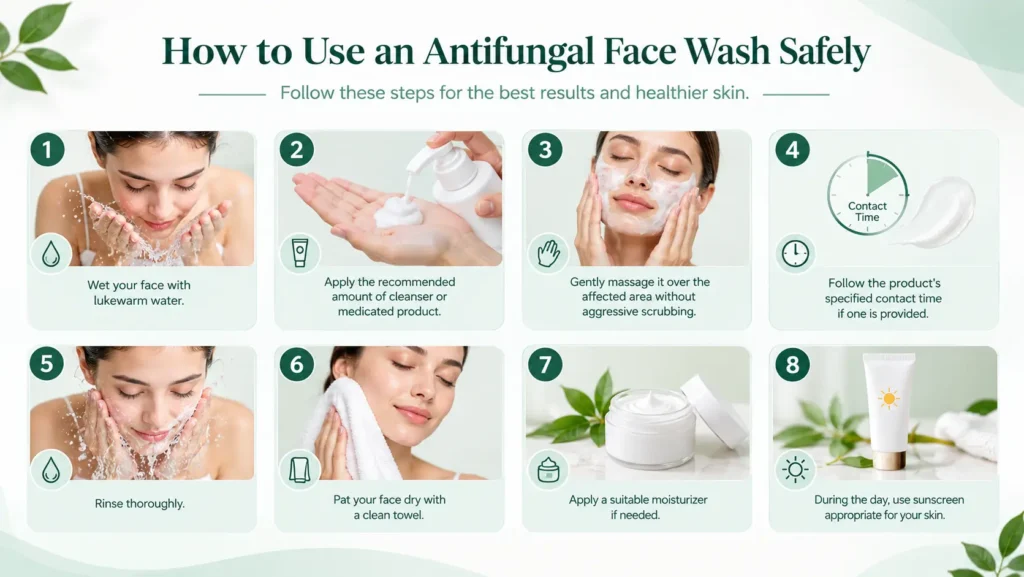
How to Use an Antifungal Face Wash Safely
If a healthcare professional has recommended an antifungal cleanser or medicated product, use it exactly as directed.
A simple routine may look like this:
- Wet your face with lukewarm water.
- Apply the recommended amount of cleanser or medicated product.
- Gently massage it over the affected area without aggressive scrubbing.
- Follow the product’s specified contact time if one is provided.
- Rinse thoroughly.
- Pat your face dry with a clean towel.
- Apply a suitable moisturizer if needed.
- During the day, use sunscreen appropriate for your skin.
Do not increase the strength, contact time, or frequency simply because you want faster results. For example, NHS guidance for ketoconazole shampoo varies according to the condition and product, demonstrating why treatment schedules should not be generalized to every antifungal product.
What to Avoid When You Have Fungal-Prone Skin
A complicated skincare routine can make it harder to identify what is helping and what is irritating your skin.
During a flare-up, consider keeping your routine simple.
Avoid:
- Aggressive physical scrubs
- Excessive cleansing
- Picking or squeezing bumps
- Introducing several new active ingredients at once
- Products that repeatedly cause burning or irritation
- Using prescription or medicated antifungals without appropriate guidance
- Assuming every acne-like breakout is fungal
Heat and humidity may also contribute to Malassezia folliculitis in susceptible people. The American Academy of Dermatology notes that these acne-like bumps can become worse in hot, humid environments.
Keeping the skin comfortable and avoiding unnecessary irritation can make a skincare routine easier to tolerate.
Antifungal Face Wash for Different Skin Types
For Oily Skin
Oily skin may feel comfortable with a lightweight cleanser, but oiliness alone does not mean you have fungal acne.
Look for a cleanser that removes excess oil without leaving the face excessively tight or irritated. If fungal folliculitis is confirmed, the active antifungal treatment should be selected according to the condition rather than simply choosing the strongest oil-control cleanser.
For Dry Skin
Dry skin requires extra attention to the skin barrier. A medicated antifungal product may sometimes cause additional dryness or irritation, so avoid combining it with several harsh exfoliants unless advised by a professional.
A simple cleanser and a compatible moisturizer can help support the barrier around a treatment routine.
For Sensitive Skin
Sensitive skin may react more easily to fragrance, essential oils, strong exfoliants, or frequent medicated cleansing.
If you experience significant burning, swelling, worsening redness, or persistent irritation, stop using the product and seek professional advice.
When Should You See a Dermatologist?
Not every itchy bump or flaky patch is fungal.
A dermatologist can distinguish Malassezia folliculitis from conditions such as acne vulgaris, bacterial folliculitis, and other skin disorders. DermNet notes that Malassezia folliculitis can be difficult to distinguish clinically from acne and bacterial folliculitis, and laboratory examination may sometimes be used to confirm the diagnosis.
Professional evaluation is especially useful when:
- Your symptoms keep returning
- Your skin is getting worse despite treatment
- The diagnosis is unclear
- The rash is spreading
- You have significant pain, swelling, or irritation
- Treatment repeatedly fails
- The affected area is close to your eyes
- You have another medical condition or take medicines that affect immunity
If a treatment containing ketoconazole has not improved the relevant skin condition within the expected timeframe, NHS guidance recommends speaking with a pharmacist or doctor rather than simply continuing or increasing treatment yourself.
Final Thoughts on Choosing an Antifungal Face Wash
The right antifungal face wash is not necessarily the product with the strongest ingredients or the most impressive marketing claims. The important question is whether the cleanser matches the actual skin condition.
For Malassezia-related folliculitis and seborrhoeic dermatitis, medically recognized antifungal ingredients such as ketoconazole and selenium sulfide can have an important role.
If your breakout consists of persistent, uniform, itchy bumps that do not respond to your normal acne routine, consider getting the condition properly assessed before switching between multiple products.
Once the cause is understood, choosing the best antifungal face wash becomes much simpler: focus on the appropriate active ingredient, a tolerable formula, correct usage, and a skincare routine that does not unnecessarily damage your skin barrier.
This article is for general educational purposes and does not replace an individual diagnosis or treatment plan from a qualified healthcare professional.